Our Roots in Nature
From degraded wetlands to thriving habitat corridors, the story of biodiversity credit investing begins long before any transaction.

1
Restored wetland habitat, Canada
An aerial photograph capturing a restored Canadian wetland teeming with native vegetation and migratory waterfowl, illustrating the tangible ecological outcomes that biodiversity offset credit projects are designed to achieve over a multi-year horizon.

2
Protected boreal forest reserve
Towering boreal trees form a dense canopy in a protected Canadian forest reserve, representing the kind of verified ecological asset that underpins the generation of biodiversity net-gain credits traded through structured offset frameworks.
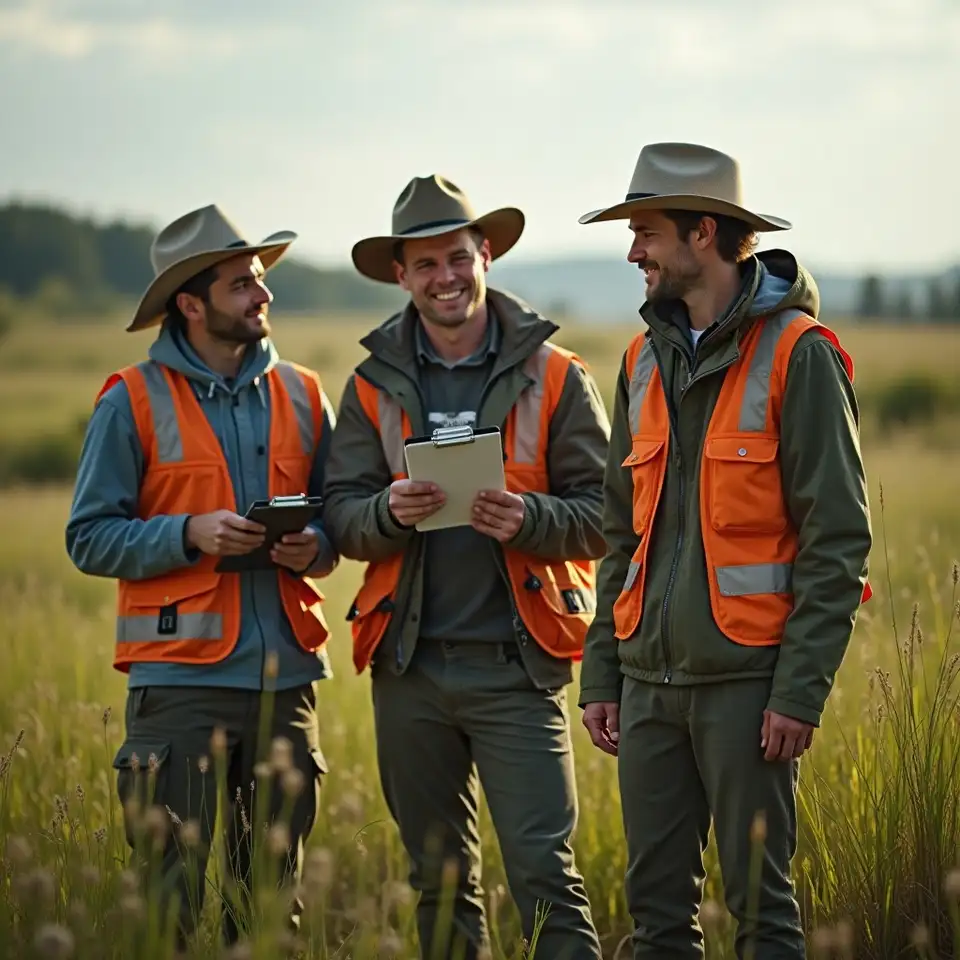
3
Field verification in progress
A team of environmental scientists conducting a biodiversity baseline survey across a native Canadian grassland, documenting species richness and habitat condition as part of the rigorous verification process required before credits can be formally recognised.
Once, Nature Was Simply the Place Where Business Left Its Footprint Behind
Today, a growing number of institutional voices argue that protecting and restoring natural systems is itself a disciplined, long-horizon endeavour worth serious analytical attention.
There was a time when ecological value sat outside every balance sheet, invisible to the
frameworks that shaped capital allocation decisions.
Biodiversity net-gain credits emerged from a simple but profound reframe: if a development project removes habitat, that loss must be measurably offset by restoration or protection elsewhere. Regulators in jurisdictions across the globe, including Canada, began codifying this principle into law, creating a structured demand signal for verified ecological outcomes.
The credit itself represents a unit of measurable biodiversity uplift — assessed against peer-reviewed habitat condition metrics, independently verified by qualified ecologists, and registered on traceable ledgers. It is not an abstraction. It is a documented ecological change, tied to a specific landscape, monitored across a defined period.
Orgulcoernuilyar exists to help analytically minded participants understand this emerging asset
category — how credits are generated, what verification frameworks govern their
integrity, and how they sit alongside other environmental instruments within a broader
view of resource allocation across a three-to-five year strategic horizon.
A biodiversity credit without independent verification is like a map without a scale — it
points somewhere, but nobody can agree how far.
The Verification Layer: Where Ecological Rigour Meets Market Credibility
The integrity of every credit hinges on the robustness of the methodology behind it, and that methodology is anything but simple.
Habitat condition assessments follow standardised scoring frameworks — such as Environment and Climate Change Canada's biodiversity metrics — that measure species richness, structural complexity, and ecological connectivity. A qualified ecologist visits the site, scores it against a baseline, and the delta between degraded and restored states becomes the quantified credit.
Independent third-party auditors then review the assessment, checking field data against satellite imagery, historical records, and peer-reviewed benchmarks. This layered scrutiny is what separates a credible credit from a paper promise. The audit trail is not a formality — it is the product itself.
Once verified, credits are registered on transparent, publicly accessible platforms that
record issuance, transfer, and retirement. Permanence provisions — legal covenants,
conservation easements, or government-backed protections — bind the land to its ecological
commitment for the duration agreed at issuance, often spanning decades.

Rooted in Place, Measured by Science
Canada's ecological assets, carefully documented
Canada's vast and varied landscapes — from prairie potholes to coastal
old-growth — are not interchangeable. Biodiversity credits are inherently local,
which means the underlying habitat restoration or protection must occur within the
same ecological region as the impact it offsets. This geographic specificity is a
feature, not a constraint. It ensures that the ecological benefit lands where the
ecological cost was incurred, preserving the functional integrity of regional food
webs, hydrology, and species migration corridors. Orgulcoernuilyar's analytical work
focuses on understanding these regional nuances: which habitat types are in highest
demand under current and anticipated regulatory frameworks, how long verification
cycles typically run, and what factors influence the long-term durability of a
credited site. Understanding these dynamics is the foundation of any serious,
informed engagement with biodiversity net-gain as an asset category.
The Principles That Shape How Orgulcoernuilyar Approaches This Work
Ecological Integrity Is the Foundation, Not the Footnote
Every credit discussed on this platform traces back to a real landscape, a
documented baseline, and a measurable change in habitat condition. The ecological
outcome is not incidental to the analysis — it is the analysis. Orgulcoernuilyar approaches
biodiversity net-gain from the ground up, beginning with the science before turning
to the market dynamics that surround it.
Transparency in Methodology Builds Durable Confidence
The verification frameworks governing biodiversity credits are complex, but they are
not opaque. Orgulcoernuilyar believes that helping participants understand the mechanics of
credit generation — habitat scoring, independent auditing, registry protocols — is
the most honest form of engagement with this asset category. Clarity about process
is clarity about value.
A Long Strategic Horizon Is the Natural Fit for Nature-Based Assets
Ecosystems do not recover on a quarterly reporting cycle. Biodiversity net-gain
credits are designed around multi-year permanence commitments, which means
analytical engagement with them demands a three-to-five year strategic lens at
minimum. Orgulcoernuilyar's approach reflects this temporal reality, resisting the
temptation to compress ecological timelines into short-term frames.
Regulatory Literacy Is as Important as Ecological Literacy
Canada's biodiversity offset frameworks are evolving — federal species-at-risk
legislation, provincial land-use planning requirements, and municipal net-gain
policies all intersect in ways that shape which credits are recognised and where.
Orgulcoernuilyar tracks these regulatory developments carefully, because the demand for
credits is ultimately a function of what the law requires.
Informed Engagement Begins with Honest Framing
Biodiversity net-gain credits are an emerging, evolving asset category. Past
performance of analogous instruments does not guarantee future results. Orgulcoernuilyar is
committed to presenting this space with the nuance it deserves — acknowledging
uncertainties, flagging verification risks, and avoiding the kind of breathless
optimism that obscures the complexity underneath.
Understanding the Canadian context means reading several policy layers simultaneously, from federal to municipal.
Federal initiatives under the Species at Risk Act and the proposed Nature Accountability Act are creating clearer demand signals for verified biodiversity outcomes. Provinces like British Columbia and Ontario are developing their own offset frameworks, each with distinct habitat classification systems and verification requirements. The result is a patchwork that rewards those who invest the time to understand it.
On the supply side, landowners — from Indigenous communities managing traditional
territories to private agricultural operators — are beginning to explore how
conservation stewardship of their land can generate credits. The negotiation between
ecological ambition and practical land management is one of the most interesting
tensions in the space, and it shapes the quality and volume of credits available in any
given region.
Orgulcoernuilyar's analytical work maps these supply and demand dynamics across Canadian ecological zones, identifying where regulatory pressure is strongest, where high-condition habitats remain available for protection or restoration, and what verification timelines participants should realistically anticipate before a credit reaches the point of formal recognition.
What Distinguishes a High-Integrity Credit from a Low-Integrity One
Not all biodiversity credits are created equal. The difference between a robust credit and a fragile one comes down to a handful of technical and legal factors that Orgulcoernuilyar tracks closely across the Canadian market landscape.
1
Additionality: The Counterfactual Test
A credit is only credible if the ecological improvement would not have happened without the offset mechanism. Additionality requires demonstrating that the land was genuinely at risk of degradation, and that the conservation activity was not already legally required. This counterfactual test is the most contested element of any credit's integrity assessment.
Permanence: The Duration Commitment
Credits tied to short-duration agreements carry reversal risk — if the conservation covenant lapses, the ecological benefit can be lost. High-integrity credits are backed by legal instruments that bind the land for periods aligned with the ecological timeline of the habitat type, often spanning several decades or longer.
3
Measurability: The Scoring Rigour
Habitat condition scores must be derived from field-based assessments using peer-reviewed metrics, not desktop estimates. The granularity of the scoring — how many species, structural layers, and connectivity attributes are measured — determines how defensible the credit unit is under regulatory scrutiny or third-party challenge.
4
Leakage Control: The Boundary Question
Protecting one site can sometimes displace harmful activity to an adjacent area, negating part of the ecological gain. Robust credit methodologies include leakage buffers — quantitative discounts applied to the credit total that account for the statistical probability of displaced impact within the broader landscape.
Registry Transparency: The Audit Trail
Credits registered on publicly accessible, tamper-resistant platforms with full issuance, transfer, and retirement records carry a traceable provenance that privately negotiated instruments cannot match. Registry transparency is a minimum standard of credibility, not an optional enhancement, in Orgulcoernuilyar's analytical framework.
Our Approach
Orgulcoernuilyar was built around a single conviction: that biodiversity net-gain is a serious subject that deserves serious analytical treatment, free from the noise of hype cycles and the shortcuts of oversimplification. The team brings together expertise in ecological science, environmental law, and alternative asset analysis.
The work is methodical by design. Every piece of analysis begins with the ecological baseline, moves through the verification framework, and arrives at the market context — in that order, without exception. This sequencing reflects a belief that understanding the asset begins with understanding the land it came from.